
India's Waste Wake-Up Call: SWM Rules, 2026 Explained
- Siya Jangir
- May 12
- 6 min read
Abstract
The new Solid Waste Management Rules have come into effect since April 2026. This blog analyses whether the Rules, being heralded as a turning point in solid waste management in India, are likely to fulfil their stated aims or inherit the same implementation challenges as the erstwhile framework.
Introduction
Solid Waste Management Rules, 2026 (SWM Rules, 2026) came into effect from 01 April 2026. The new rules mark a significant departure from the earlier solid waste management framework under the Solid Waste Management Rules, 2016 (“SWM Rules, 2016” or “the 2016 Rules”) . Solid waste management includes a spectrum of activities spanning the generation, storage, collection, transfer, transport, processing, and disposal of solid waste. Solid waste management in India is a behemoth task and has always been a major challenge, particularly for urban municipal bodies. According to the Central Pollution Control Board(“CPCB”) Annual Report 2022-23 on Implementation of the Solid Waste Management Rules, 2016, the overall quantity of solid waste generated stands at 1,70,939 tons per day (TPD) in the country. The sheer volume of waste generated in cities presents a veritable hurdle on the road to sustainable long-term waste management solutions. While waste collection has improved over the last few decades, large volumes still end up in landfills. Although landfilling is a common destination for most waste, this process results in the accumulation of waste at disposal sites, depleting the Earth's assimilative capacity and causing environmental pollution. India’s massive landfills pose serious health risks and signal long term environmental damage. Delhi’s infamous landfill mountains are the most conspicuous examples of the failure of solid waste management in cities. Landfills in Bhalaswa, Ghazipur and Okhla have especially become symbols of the failure of waste segregation. Considering the sheer scale of the issue, along with the inefficacy of the erstwhile rules, the new rules envisage a regime oriented towards greater compliance and accountability.
Problems with the Solid Waste Management Rules, 2016
SWM Rules, 2016 were a significant step in the right direction. They were widely regarded as progressive for their time. The rules expanded the scope of waste governance. It was through the SWM Rules 2016 that waste segregation was formally introduced and seeped into the general discourse on waste management and environmental pollution. From households to schools and universities, waste segregation became a critical aspect of the colloquial conversation on waste pollution. SWM Rules, 2016 also formally recognised the role of informal waste pickers. The 2016 Rules created a duty/obligation-based framework wherein the duties of various stakeholders were clearly delineated. However, there were several issues when it came to the actual on-ground implementation. The normative intent of the erstwhile framework, however, did not translate into veritable tangible impact. This was mainly due to issues with compliance by statutory bodies. Within a year of the 2016 Rules being introduced, a report of the Hazardous Substance Management Division of the Ministry of Environment, Forest and Climate Change (“MoEFCC”) on the implementation of the rules was released, which signalled the beginning of compliance issues. The report especially focused on the implementation of the provisions with respect to Extended Producer Responsibility (“EPR”). Compliance issues persisted in the larger regard as well. This grew to an extent where, in light of chronic non-compliance, the National Green Tribunal (“NGT”) passed an order in 2020 requiring the personal presence of the Chief Secretaries of all States/UTs before it to effectively address the issue. Earlier orders of the NGT on the issue also laid down a compensation scale for continued failure to comply after 31 March 2020. The NGT’s orders on solid and liquid waste management brought to light a troubling trend when it came to compliance with the rules and this also showed the glaring gaps that ought to be addressed. As the inefficacy of the rules became increasingly prominent, it was important to address the same, and therein come the new 2026 Rules.
New Measures under the SWM Rules, 2026
The new rules introduce crucial changes to the earlier framework. The revised rules integrate the principles of the circular economy and EPR, with a specific focus on efficient waste segregation and management. The most prominent changes are discussed below.
Mandatory Four-Stream Segregation
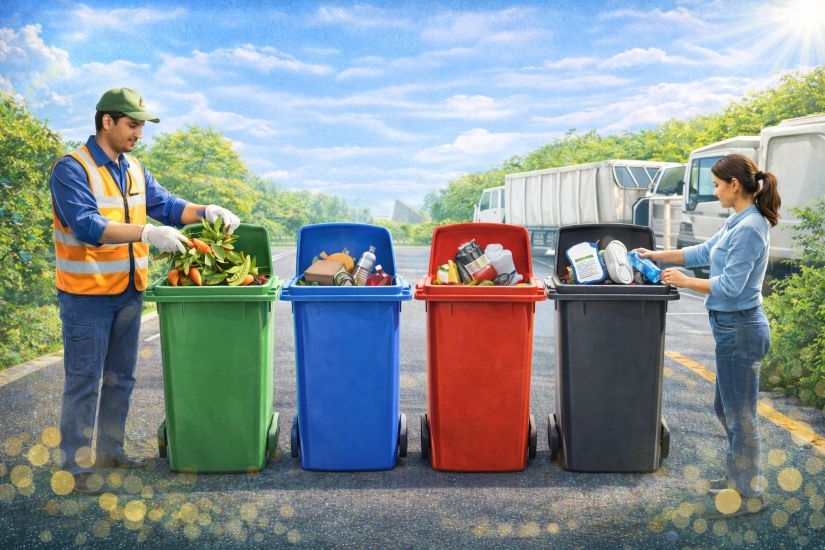
Under the 2016 Rules, waste was required to be segregated into two categories – wet waste in green bins and dry waste in blue bins. Green and blue bins came to populate most public spaces after the implementation of the 2016 Rules. However, this has now been changed into a system of mandatory four-stream segregation. Waste is now required to be segregated into the following four categories: (i) wet waste; (ii) dry waste; (iii) sanitary waste; and (iv) special care waste. Sanitary waste includes used diapers, sanitary towels, tampons and condoms, etc., which shall be securely wrapped and stored separately. Special care waste includes paint cans, bulbs, mercury thermometers, and medicines, which shall be collected by authorised agencies or deposited at designated collection centres. The creation of a special care waste category finally recognises e-waste as a separate category, which was much needed considering the ubiquity and reducing shelf life of electronic devices and gadgets.
Extended Bulk Waste Generator Responsibility (“EBWGR”)
Bulk waste generators include entities with a floor area of 20,000 square metres or more, or water consumption of 40,000 litres per day or more, or solid waste generation of 100 kg per day or more. Under Rule 6, the duties of the bulk waste generator include having to register themselves with the concerned local body through the centralised online portal and makingnecessary arrangements for collecting and handing over different kinds of waste to the local body or an agency. The bulk waste generator is also required to set up and operate a wet waste processing facility of adequate capacity, including for horticulture waste to ensure processing of all wet waste generated by them. Since bulk waste generators account for a significant chunk of total solid waste generation, this provision is expected to significantly reduce the burden on urban local bodies and promote decentralised waste management.
Landfill Rules and the Polluter Pays Principle
Rules for sanitary landfills have been substantially changed. Landfills are now only allowed to accept non-recyclable waste, non-energy recoverable waste and inert material. Additionally, sanitary landfills may now levy a user fee for unsegregated waste, which shall be higher than the collection, transportation and waste processing costs. Further, the concerned State Pollution Control Board (“SPCB”) or a registered environment auditor is required to undertake an audit of the operation of the sanitary landfill for environmentally sound disposal of non-recyclable and non-energy recoverable dry waste. The audit report for a particular financial year is required to be uploaded by the SPCB or the Pollution Control Committee on the centralised online portal.

The most crucial step forward in increasing compliance and accountability is the inclusion of the polluter pays principle in the new rules. The polluter pays principle is a general principle of international environmental law. The principle essentially calls for accountability by shifting the burden of pollution on to the polluter or polluting entity itself. This principle responds to the question of who really bears the cost of the environmental damage caused by holding that the cost should be internalized and borne by the polluter. While the underlying theoretical base is with respect to redistribution of costs, the practical aspect is that there is a consequent deterrent effect whereby, if the polluter is made accountable to pay, polluting activities are disincentivised. In India, the polluter pays principle was established and laid down in Indian Council for Enviro Legal Action v. Union of India. Since then the principle has evolved and become an essential element of the environmental law jurisprudence in India. Under the new rules, this principle has been imported into the solid waste management framework as well. Rule 17 of the SWM Rules, 2026 deals with the imposition of environmental compensation. Under this provision, environmental compensation may be imposed on all entities engaged in the waste management process for non-compliance with the standards laid down under the 2026 Rules.
Other New Measures
Other measures include, the introduction of a centralised digital portal for registration, reporting, and tracking waste flows across the country. The rules also mandate mapping and assessment of all legacy waste dumpsites and provide for time-bound biomining and bioremediation. Additionally, in order to promote circular economy, industries are required to increase Refuse Derived Fuel (“RDF”) usage from 5% to 15% over six years to replace solid fuels.
The Way Forward
The SWM Rules, 2026 bring in a host of new measures, several of which are specifically aimed at solving the problem of on-ground implementation and non-compliance thatpersisted under the earlier regime. However, it remains to be seen whether the new framework also inherits any of the same implementation challenges as the 2016 Rules.Municipal bodies have been given compliance windows of 18, 24 and 36 months,respectively, differentiated on the basis of population size, whereby larger cities are expected to comply first. There are also no new provisions addressing the informal sector, and this gap will continue to remain an issue as the new rules fail to institutionalise or adequately support informal sector workers. Informal sector workers are a crucial part of the solid waste management process, and they need to be recognised as stakeholders in the larger picture in order to develop systems that are better suited to the social reality. Without systemic improvements in monitoring, infrastructure and structural social change policies, the SWM Rules, 2026 also risk becoming yet another well-intentioned policy that fails to translate into positive outcomes. The success and efficacy of the new rules depend not just on the textbook statutory compliance, but also on social awareness and reform initiatives focusing on citizen participation, responsible institutions, and consistent enforcement.
Comments