
Punishment by Demolition: The Bulldozer vs. The Constitution
- Aditya Diwan

- Apr 16
- 5 min read
Abstract
While the Constitution guarantees Right to Shelter, the streets tell a different story. This blog dissects the “procedural void” in Olga Tellis and the exclusionary design of PMAY-U. It argues that true housing justice requires moving beyond judicial discretion to a statutory “Right to the City” and meaningful engagement.
Introduction
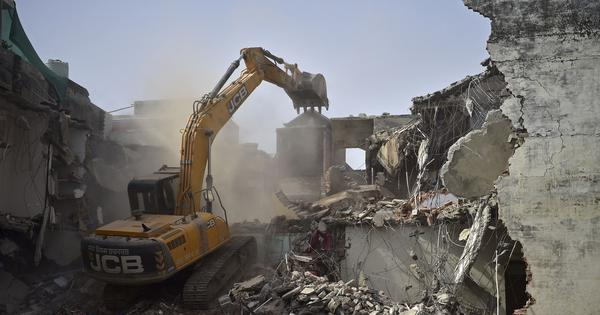
A concerning reality was recently pointed out by the Allahabad High Court with regard to the timeliness of demolitions. The Court observed that the State was weaponizing municipal laws to achieve “punitive justice”. A pointed observation made in February 2026 by a Division Bench comprising of Justices Atul Sreedharan and Siddharth Nandan stated that the Court was viewing ‘colourable exercise of power’ with a “very troubling frequency”, in such demolition notices being issued of an accused’s home, just hours after an FIR against him. This judicial intervention lays bare the brutal reality of urban governance in India today and the “Right to Shelter”, facing the most serious existential threat from the excess executive spite rather than a lack of resources. The procedure employed is extremely predictable by the State and coordinated, a person is accused of an offense and within hours his house is labelled “encroachment” and demolished, making this new brand of “bulldozer justice” override the Rule of law established in Olga Tellis, through loopholes like the ‘public land’ provision circumventing even the Apex Court’s directions issued in 2024, thereby creating an almost parallel justice system where jail term isn't the punishment for a crime, but demolition of an accused’s home is. The “Right to Shelter” is rendered meaningless if the same can be withdrawn by State machinery as an instrument of political punishment.

In this blog, the Author critically analyses the contemporary model of bulldozer justice and argues how authorities weaponize municipal law for punitive demolitions of residences of the accused, leveraging the loopholes in the ‘public land’ provisions to undermine Supreme Court protections. To counter such threat to the Right to Shelter, the author proposes shifting away from forced evictions to a system where the Right to Negotiate through a legal framework, following South African constitutionalism, becomes the norm. The author draws upon an array of Indian jurisprudence including Olga Tellis and recent High Court pronouncements; South African judgments on meaningful engagement; as well as, demolition data empirically compiled from Amnesty International and the Housing Land Rights Network to argue his case.
The Judicial Shield: Tracing the arc of Protection
Before analyzing how the constitutional shield that it wishes to pierce, needs to be studied in the present context. The Judiciary has been erecting the “shield” for the urban poor for decades, the starting point being the landmark judgment in Olga Tellis. Here, the Supreme Court interpreted the “Right to Livelihood” as guaranteed by Article 21, stating that evicting a pavement dweller from their abode isn’t merely displacement from a shelter, but deprives the dweller of their source of sustenance. This judicial arc was expanded further in Chameli Singh, wherein the Court declared that the Right to Shelter entailed not just having a roof above one’s head, but also access to basic facilities like water and electricity, thereby converting the slum dwellers into citizens, not squatters.
Adding to the legal lock on the Right to Shelter, two pronouncements of the Delhi High Court namely Ajay Maken and Sudama Singh, brought forth the concept of “Right to City”, stating that no one could be evicted without a proper survey and a rehabilitation plan on the grounds that the urban poor were essential contributors and not encroachers. The most conclusive step in the judicial evolution of Right to Shelter, cumulating all rights arrived in a referential judgment by the Apex Court in November 2024, In Re: Directions in the Matter of Demolition of Structures, explicitly prohibiting punitive demolitions and mandating a stringent fifteen-day show-cause notice before a structure can be demolished.
This legal framework theoretically seems airtight, but it appears that, as pointed out recently by the Allahabad High Court in a judicial interpretation of this provision, the executive has found a way around this constitutional right through “procedural loopholes”.
Weaponizing Procedure: The Loophole of ‘Legal’ Demolitions
Although the judiciary has designed an impregnable judicial fortress, the executive continues to find ways around this fortress through calculated “procedural” loopholes. In its November 2024 referential order, the Apex Court explicitly carved out an exception for “unauthorized structures on public land”. The state now uses this exception to bypass strict procedural compliance for punitive demolitions and calls them routine ‘encroachment removal drives’ and ‘riverfront beautification’.
As reported in June 2024, more than 1,800 structures were demolished in Akbarnagar under the name of the ‘Kukrail Riverfront Project’, despite residents owning electricity meters and tax receipts, displacing approximately 10,000 citizens. This isn’t an isolated occurrence but a national phenomenon, with, as per Housing and Land Rights Network (HLRN), 1.53 lakh homes demolished, displacing 7.4 lakh people between 2022-2023, at the rate of 58 people being displaced per hour. Such punitive demolition measures used as a form of “collective punishment” were also evidenced by Amnesty International which recorded, in a period of 3 months in 2022, 128 properties being demolished across five states post-communal riots, all without due process.
Labelling demolition on ‘public land’ helps circumvent all constitutional rights under Olga Tellis by providing the machinery a loophole in its operation making bulldozers into instruments of extrajudicial justice by operating in a grey area.
Bulldozers vs. Dialogue: Why India Needs a ‘Right to Negotiate’
If what India suffers from is the abuse of procedure, then the answer cannot be anything other than a radical redesigning of the State’s responsibility from eviction to negotiation.
Whereas Indian courts currently concern themselves with the number of days for which notice is given (15 or 24 hours), the Constitutional Court of South Africa has established a much better threshold in Grootboom, where the court declared that a housing programme was invalid because it could not cater for people “in desperate need”, thereby placing a burden on the state to treat survival as more important than aesthetics. In a case concerning occupation rights, Olivia Road, the Court innovated a new doctrine of “Meaningful Engagement” where, unlike in India, where notice and cause for show cause are just a preliminary formality to be completed before the arrival of the bulldozer, the state was required to engage with the occupiers to find a workable solution even before the question of an eviction order arose.
By adopting this norm in India, the “public land” loophole would be wholly closed, as the State could not escape its obligation using the technical defence of “encroachment” and would instead be constitutionally bound to treat the slum dweller not as an offender to be punished, but as a citizen to partner with.
Conclusion: From Executive Whim to Statutory Shield
The Indian judiciary spent 40 years of tireless effort in providing a fort of rights around the urban poor which, in the light of events in 2026, appears to be made of paper walls. The right to shelter, as long as it rests on judicial discretion and procedural niceties, can never survive executive apathy and political vindictiveness.
The remedy is not another judgment but the enactment of the said mandate in a National Right to Shelter Act. This should not limit itself to the “four walls” definition of housing but expand into Henri Lefebvre’s “Right to the City” in order to guarantee the right to inhabit, occupy and change space in cities without any threat of state violence.
The State must change the legal paradigms from “encroachment” to “entitlement” and from vindictive demolition to “meaningful engagement” in order to uphold Olga Tellis’ broken promise. A city where its builders are regarded as “encroachers” to be punished cannot be called a “Smart City”; it is a constitutionally bankrupt one.



Comments